Thursday, July 26, 2018

2018 National Trademark Exposition, July 27-28, 2018, Washington, D.C.

2018 National Trademark Exposition

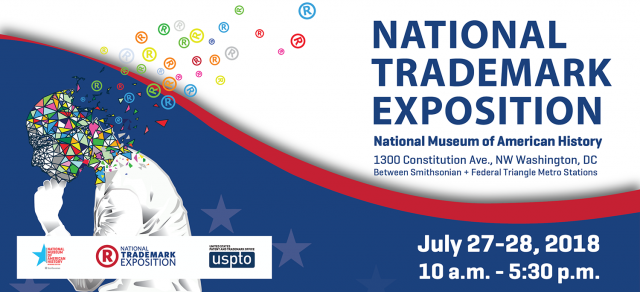
National Trademark Exposition -- July 27-28, Smithsonian National Museum of American History
The Smithsonian's National Museum of American History, in collaboration with the United States Patent and Trademark Office, will host the 2018 National Trademark Exposition.  The exposition is a free, family-friendly event where you can learn about trademarks.  It will feature educational workshops, exhibits and hands-on activities demonstrating the important role trademarks play in our economy and our lives. Children's activities, including scavenger hunts, interactive games, and trademark design workshops, will be offered both days.  Free continuing legal education (CLE) seminars will be offered for legal professionals.

Exhibitors

  • 1000 Cranes, LLC
  • American Intellectual Property Law Association (AIPLA)
  • DC Rollergirls
  • Edible IP, LLC (DBA Edible Arrangements)
  • Girl Scouts Nation’s Capital
  • Global Brand Council, U.S. Chamber of Commerce
  • International Trademark Association (INTA)
  • Looshes Labs LLC
  • Microsoft
  • NASA Goddard Space Flight Cente
  • National Park Service (United States Department of the Interior) and National Park Foundation
  • NumbersAlive!
  • Politics and Prose
  • Safeway
  • Segway Inc.
  • Tenneco Automotive
  • The National Institute on Deafness and Other Communication Disorders
  • Under Armour, Inc.
  • Velcro Companies 
  • YMCA

Wednesday, July 25, 2018

Au Revoir, Droit de Suite—9th Circuit Narrows California Resale Royalty Act to a Single Year’s Sales; Lexology, July 9, 2018

South Africa’s Proposed Copyright Fair Use Right Should Be A Model For The World; Intellectual Property Watch, July 24, 2018

Intellectual Property Watch; South Africa’s Proposed Copyright Fair Use Right Should Be A Model For The World

[Kip Currier: I'm teaching 15 online students in my Intellectual Property and "Open" Movements course this Summer Term and posted this announcement on our Courseweb site today:


I highly recommend reading this article, especially as a capstone to the material we have explored this term and in conjunction with your reading of this course's final required text, Reclaiming Fair Use by Pat Aufderheide and Peter Jaszi.

Questions to consider:
  • What did you notice about fair use from reading the article?
  • In what ways does U.S. fair use compare with South Africa's proposed fair use right?
  • What are some ways that the proposed South Africa fair use right may impact copyright holders, users, and other stakeholders?
  • Did you notice which persons and organizations are the authors of the article?
  • How about that fair use is a "defense" in the U.S. and a "right" in the South African proposal?
  • How does the proposed South African fair use right compare and contrast with the recent controversial European Union Copyright Directive?
  • What else...?]


"Sean Flynn, American University Washington College of Law
Michael W. Carroll, American University Washington College of Law
Peter Jaszi, American University Washington College of Law
Ariel Katz, University of Toronto, Faculty of Law
Leandro Mendonça, Universidade Federal Fluminense (UFF), Cultural Production Department
Diane Peters, Creative Commons Corporation (HQ)
Allan Rocha de Souza, Federal University of Rio de Janeiro (UFRRJ)

In addition to a set of more open specific exceptions, the South Africa bill contains a well-crafted and unique general exception for “fair use.” The magic of the South African general exception is not in adopting the term “fair use.” The phrases “fair use” and “fair dealing” mean the same thing. The key change is the addition of “such as” before the list of purposes covered by the right, making the provision applicable to a use to a use for any purpose, as long as that use is fair to the author...

We believe that the South African proposal gets it just right. We commend its Parliament on both the openness of this process and on the excellent drafting of the proposed fair use clause. We are confident it will become a model for other countries around the world that seek to modernize their copyright laws for the digital age."

Tuesday, July 24, 2018

My terrifying deep dive into one of Russia's largest hacking forums; The Guardian, July 24, 2018

Dylan Curran, The Guardian; 

My terrifying deep dive into one of Russia's largest hacking forums


[Kip Currier: I had a similar reaction to the author of this article when I attended a truly eye-opening 4/20/18 American Bar Association (ABA) IP Law Conference presentation, "DarkNet: Enter at Your Own Risk. Inside the Digital Underworld". One of the presenters, Krista Valenzuela with the New Jersey Cybersecurity and Communications Integration Cell in West Trenton, New Jersey, did a live foray into the Dark Web. The scope of illicit activities and goods witnessed in just that brief demo was staggering and evoked a feeling that scenes of "black market" contraband and "bad actors" endemic to dystopian sci-fi fare like Blade Runner 2049 and Netflix's Altered Carbon are already part of the present-day real-world.]

"It’s fascinating to see how this community works together to take down “western” systems and derive chaos and profit from it. Typically, hackers in first-world countries are terrified to work together due to the multiplicative risk of a group being caught. In Russia, however, the authorities don’t seem to care that these hackers are wreaking havoc on the west. They are left to their own devices, and most users on this forum have been regular members for over six years.

A lot of the information on this forum is incredibly worrying, even if a lot of it is harmless 15-year-olds trying to be edgy and hack their friend’s phones. In any case, it’s important to know these communities exist. The dark underbelly of the internet isn’t going anywhere."

Monday, July 23, 2018

Native Tribes Can’t Shield Patents From USPTO Review; Intellectual Property Watch, July 21, 2018

Steven Seidenberg, Intellectual Property Watch; Native Tribes Can’t Shield Patents From USPTO Review

"The strategy was breathtaking in its boldness. Just days before the USPTO was to hear a challenge to Allergan Inc.’s patents on a dry-eye drug, Restasis, the company transferred those patents to a Native American tribe; the tribe then sought to dismiss the USPTO proceedings by asserting sovereign immunity. Following this action, a number of other patentees made similar transfers to Native tribes, in order to protect their patents. More patentees were poised to do so, should this ploy prove effective. It, however, did not. On 20 July, the Federal Circuit Court of Appeals ruled the tribe’s sovereign immunity did not protect its patents from USPTO review. The ruling thus kept intact a key component of America’s patent system."

Sunday, July 22, 2018

Farting unicorn row: artist reaches settlement with Elon Musk; The Guardian, July 21, 2018

Damien Gayle, The Guardian; Farting unicorn row: artist reaches settlement with Elon Musk

"A Colorado artist says he has reached a settlement with Elon Musk after challenging the Tesla tycoon’s use of a farting unicorn motif that he had drawn as an ironic tribute to electric cars.

Musk used the cartoon image on Twitter, without attribution, to promote his Tesla electric car range, and ignored Tom Edwards’ attempts to come to a licensing arrangement, telling the artist’s daughter it would be “kinda lame” to sue."

Saturday, July 21, 2018

Two men charged with stealing more than $8 million in rare books from Carnegie Library; The Pittsburgh Post-Gazette, July 20, 2018

Paula Reed Ward, The Pittsburgh Post-Gazette; Two men charged with stealing more than $8 million in rare books from Carnegie Library 

[Kip Currier: This is a deeply troubling "library theft" and "breach of the public trust" story, with enormous implications about ethics, management, leadership, and Board responsibility and oversight. It'll definitely be a case study in my courses at the University of Pittsburgh and in the ethics textbook I'm writing.

Reading the Perry Mason-esque True Crime-confessional details (e.g. Priore: "greed came over me. I did it, but Schulman spurred me on") in The Post-Gazette's front-page article brought to mind the oft-heard adage "Crime doesn't pay"--a favorite slogan of the FBI, starting in 1927, and then used in the comic strip Dick Tracy in 1931.] 


"It ranks as one of the largest library thefts in history.

Greg Priore, 61, of Oakland, who worked as the sole archivist and manager of the library’s rare book room since 1992, is charged with theft, receiving stolen property, conspiracy, retail theft, library theft, criminal mischief and forgery.

John Schulman, 54, of Squirrel Hill, who owns Caliban Book Shop, is charged with theft, receiving stolen property, dealing in proceeds of illegal activity, conspiracy, retail theft, theft by deception, forgery and deceptive business practices...

“Priore explained that he took a lot of maps and pictures – in all possibly 200 items – from the Oliver Room. Priore then stated ‘You got me, I screwed up.’ He also stated, ‘Please tell [library executive director] Mary Frances [Cooper] I am sorry and I let the whole place down.’”"