Wednesday, February 13, 2019

Lack of women inventors could hurt innovation, US patent office says; CNet, February 12, 2019

Erin Carson, CNet; Lack of women inventors could hurt innovation, US patent office says

"More women are filing patents, but they still have a long way to go in terms of representation among inventors, according to a report out Monday from the US Patent and Trademark Office.

The report, titled Progress and Potential: A profile of women inventors on US patents, found that while the share of patents that include at least one woman listed as an inventor rose from 7 percent in the 1980s to 21 percent in 2016, women accounted for only 12 percent of inventors in 2016. 

"Harnessing underexploited talent in these groups would be valuable to spurring innovation and driving growth," reads the report, whose release coincided with the International Day of Women and Girls in Science. It refers to the idea of "lost Einsteins," or people who could have made valuable contributions had they been exposed to "innovation and inventor role models."" 

Colorado Open Scholars Summit to examine ‘Open Access in Tenure and Promotion’ March 1; Colorado State University, February 9, 2019

CSU External Relations Staff, Colorado State University; Colorado Open Scholars Summit to examine ‘Open Access in Tenure and Promotion’ March 1

"The second biennial Colorado Open Scholars Summit, a statewide event co-sponsored by nine Colorado universities, will be held on March 1 in the Morgan Library Event Hall at CSU.

The focus of this year’s event, being held from 10 a.m. to 2 p.m., is “Open Access in Tenure and Promotion.” The summit will consist of two virtual panels featuring renowned scholars from the U.S. and Canada, followed by local discussions at the nine participating Colorado institutions, including CSU.

The first panel features CSU’s own Patrick Burns, dean of libraries and vice president of information technology, and will be a general discussion of challenges within the tenure and promotion process. This panel will focus on evaluation of scholarly and creative output, with particular attention paid to disincentives built into the T&P process and challenges in evaluating multidisciplinary and non-traditional scholarship.

The second panel will explore the topics of equity, prestige and quality of scholarship, with particular focus on the effect of open access on these areas of T&P evaluation."

Disney lobbies Congress to change copyright laws; The Highlander, University of California Riverside, February 12, 2019

Robert Gold, University of California Riverside; Disney lobbies Congress to change copyright laws

"Copyright law is a tedious topic but it affects people in their daily lives."

Thursday, January 31, 2019

USPTO Releases 2018 Performance and Accountability Report; Guest Blog by Chief Financial Officer Tony Scardino, January 31, 2019

Director's Forum: A Blog from USPTO's Leadership
Blog homepage | A tribute to veteran... »
Thursday Jan 31, 2019 
 
USPTO Releases 2018 Performance and Accountability Report 

Guest Blog by Chief Financial Officer Tony Scardino

"I’m pleased to announce that the USPTO has published its Performance and Accountability Report (PAR) for fiscal year (FY) 2018. The PAR serves as the USPTO’s annual report, similar to what private sector companies prepare for their shareholders. Each year the USPTO publishes this report to update the public on our performance and financial health.

Our FY 2018 PAR charts the agency’s progress toward meeting goals outlined in our 2014-2018 Strategic Plan: optimizing patent quality and timeliness; optimizing trademark quality and timeliness; and providing domestic and global leadership to improve intellectual property policy, protection, and enforcement worldwide. In addition, the PAR provides information on the USPTO’s progress towards a broader management goal:  achieving organizational excellence.  These goals drive the quality and quantity of our service to intellectual property stakeholders over the last five years.

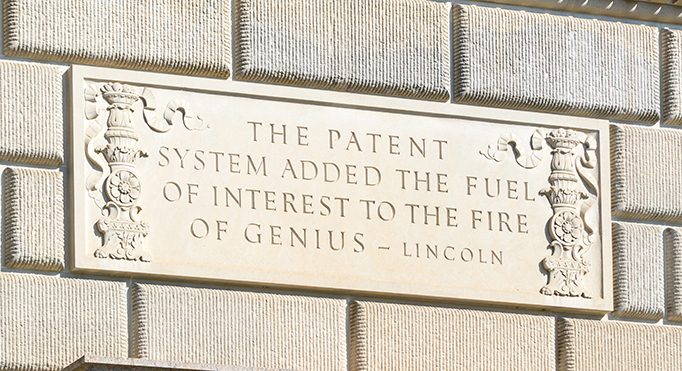
Quote by President Abraham Lincoln on the patent system
Quote by President Abraham Lincoln on the patent system, as displayed on the Herbert C. Hoover federal building in Washington D.C., headquarters of the U.S. Department of Commerce

While the PAR is a record of our achievements, it is also an honest discussion of the challenges we face as an agency moving forward under our new 2018-2022 Strategic Plan, which was published in November. We will continue efforts to issue predictable and reliable patents; continue implementation of the patent dispute resolution portions of the America Invents Act (AIA), including ensuring that procedures and standards are balanced and predictable; monitor and help address dynamic IP issues in Congress and the Courts; maintain the high and sustained trademark performance level in the face of significant trademark application growth rates; improve the customer experience and develop outreach at both headquarters and regional offices; expand on dissemination of data; maintain sustainable funding; and ensure our IT systems enable our nationwide workforce to serve our customers with a “24/7/365” operational capability.

Here at the USPTO, we take pride in producing a PAR that meets the highest standards of transparency, quality, and accountability. The PAR contains a wealth of data and historical information of interest to our stakeholders, including data on patent and trademark examining activities, application filings, and agency staffing levels. This information is conveniently presented in the workload tables section at the end of the PAR.

On the issue of financial performance, FY 2018 marks the 26th consecutive year that the USPTO’s financial statements have received an unmodified audit opinion. Our clean audit opinion gives the public independent assurance that the information presented in the agency’s financial statements is fairly presented and follows generally accepted accounting principles. The auditors did note a deficiency in our internal controls related to managing and configuring IT system access. We have already begun developing plans to address the auditor’s concerns. Despite this deficiency, the auditor found no material weaknesses in the USPTO’s internal controls, and no instances of non-compliance with laws and regulations affecting the financial statements.

The PAR is a faithful snapshot of the USPTO’s FY 2018 performance. I hope you find value in this document, and that it allows you to glean greater insights into the agency’s activities and achievements."

The Role Of The Centre For Data Ethics And Innovation - What It Means For The UK; Mondaq, January 22, 2019

Jocelyn S. Paulley and David Brennan, Gowling WLG, Mondaq; The Role Of The Centre For Data Ethics And Innovation - What It Means For The UK

"What is the CDEI's role?

The CDEI will operate as an independent advisor to the government and will be led by an independent board of expert members with three core functions3:

  • analysing and anticipating risks and opportunities such as gaps in governance and regulation that could impede the ethical and innovative deployment of data and AI;
  • agreeing and articulating best practice such as codes of conduct and standards that can guide ethical and innovative uses of AI; and
  • advising government on the need for action including specific policy or regulatory actions required to address or prevent barriers to innovative and ethical uses of data.
As part of providing these functions, the CDEI will operate under the following principles;

  • appropriately balance objectives for ethical and innovative uses of data and AI to ensure they deliver the greatest benefit for society and the economy;
  • take into account the economic implications of its advice, including the UK's attractiveness as a place to invest in the development of data-driven technologies;
  • provide advice that is independent, impartial, proportionate and evidence-based; and
  • work closely with existing regulators and other institutions to ensure clarity and consistency of guidance
The CDEI's first project will be exploring the use of data in shaping people's online experiences and investigating the potential for bias in decisions made using algorithms. It will also publish its first strategy document by spring 2019 where it will set out how it proposes to operate with other organisations and other institutions recently announced by the government, namely the AI Council and the Office for AI."

So Much TV, Too Little IP Yields Writers Rich Rewards; Variety, January 31, 2019

Elaine Low, Variety; So Much TV, Too Little IP Yields Writers Rich Rewards

"The sheer volume of television out there is changing how precious intellectual property is foraged, acquired and ultimately used."

UN agency finds US, Asian companies seek most AI patents; Associated Press, January 31, 2019

Associated Press; UN agency finds US, Asian companies seek most AI patents

"The U.N.’s intellectual property organization says companies in Japan, South Korea and the U.S. are the top filers of patent applications involving artificial intelligence.

The World Intellectual Property Organization has issued a first report aiming to show trends in AI, seen as a growth area in coming years, although still a tiny fraction of all patent applications each year.

WIPO said Thursday that machine learning is the dominant AI technique disclosed in patents."